
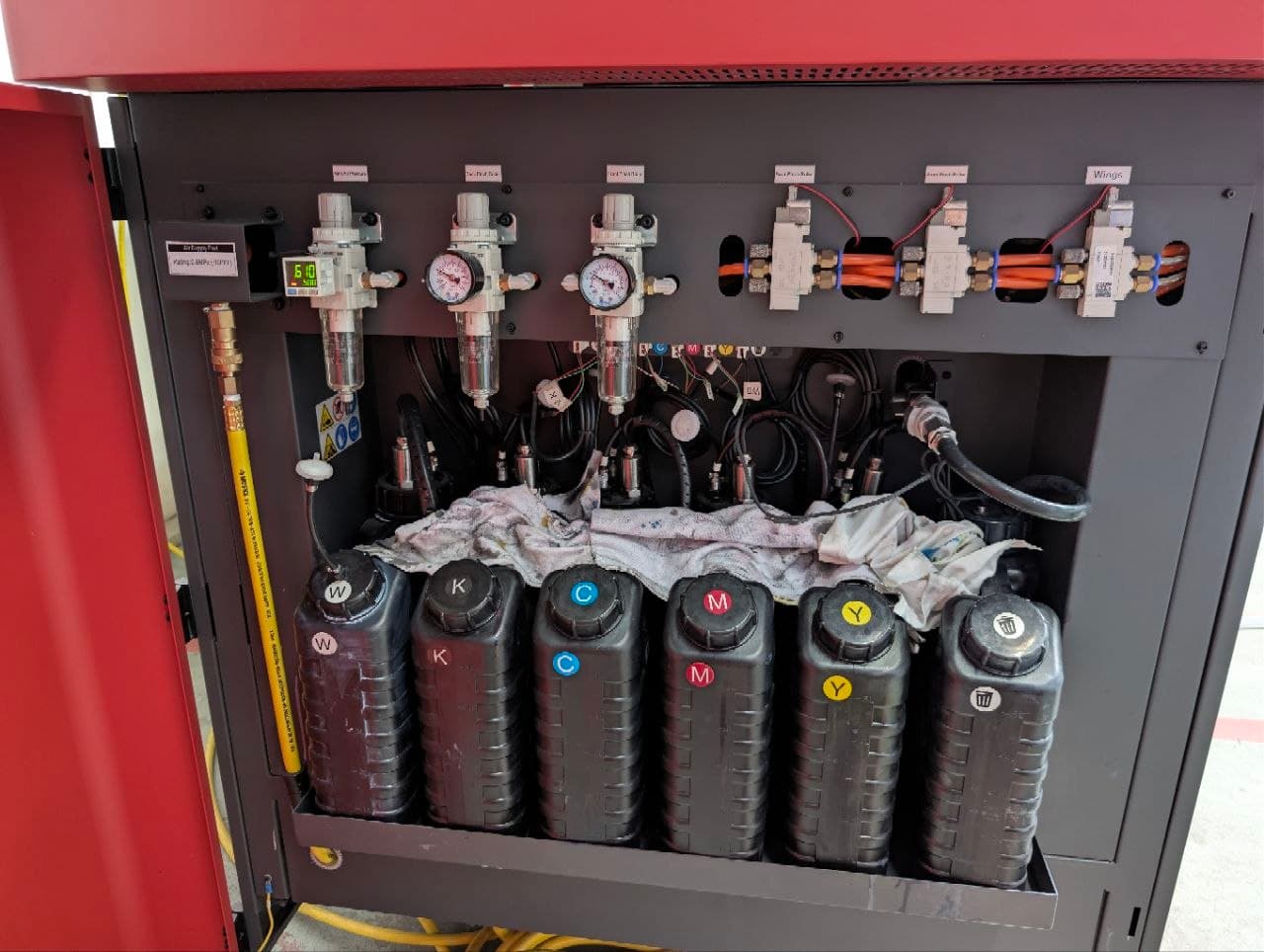
Owners of these machines bring up two problems more than any other. The first is the ink bill. One Canon Arizona owner on Reddit uses about a liter a day, pays about $250 a liter, and says their ink cost is “considerably higher than our equipment lease”. The second is the bag that stops printing while it is still full. Another owner, of an Arizona 1300 series: “once the ink ‘expires’ the machine will not run. We went through countless, nearly full, bags of ink.”
Both come from the same part: the chip, an RFID tag on every OEM ink bag, box or bottle that the printer reads before it will use the ink. Below: what that chip checks on Canon Arizona, EFI VUTEk and Fujifilm Acuity flatbeds, what shops do to get around it, and what it takes to run other ink properly. We sell chips and ink for these machines, so read the last section knowing that.
What the chip on an OEM bag checks
The printer reads the tag and compares it with what it expects. It checks the ink type for that machine, the color for that slot, a valid serial number and a use-by date. On some machines it also counts how much ink has been drawn from the bag.
| Machine | What the documentation or owners say |
|---|---|
| Canon Arizona | The 400 series manual: when a bag “with an invalid serial number, expired use-by date, incorrect color, or expired tag is connected to the printer, the operator is alerted.” Owners report a short grace period after expiry, after which the bag is rejected. |
| EFI VUTEk | The QS series operator’s guide: “The printer detects expired ink dates and does not allow printing.” It gives UV ink “a typical shelf life of approximately 12 months.” Owners report that the tag also counts volume. |
| Fujifilm Acuity | Owners report that the expiry date is on the chip and that there is no way to override it. Some say their ink arrived with four to six months of shelf life left. |
Sources: Océ Arizona 400 GT manual, EFI VUTEk QS guide; owner reports on Signs101 and PrintPlanet.
So the chip does two jobs. One is useful: it keeps the wrong ink out of the heads. On an Arizona, owners report that the 2xx inks run under mercury lamps and the 3xx inks under LED, and that one will not work in the other’s machine. The other job is the one owners complain about. It ties the machine to one source of ink at one price, with a clock running on every bag.
The workarounds, and why they don’t last
Shops have tried three things.
- Setting the clock back. Owners describe rolling the PC or BIOS date back, so an expired bag reads as valid. On an Acuity, one owner found that Windows set the date straight back: “When the ink is expired, it’s gone.”
- Reusing tags. The tag or coupling from an empty OEM bag stays in place and other ink is fed behind it. Owners report that the tags expire too.
- Resetters and emulators.These are sold openly. STS sells a VUTEk “Smart Resetter”, “an emulator of the Vutek bag identification system”, at $220 per color.
Each of these keeps the printer quiet, and none of them changes what is in the lines. If the new ink’s chemistry differs from the old, the two mix in the dampers and the heads. A rolled-back clock keeps expired ink printing, and expired ink is what owners report gelling in lines and heads.
Firmware is the other risk. On Mimaki machines, owners report third-party chips that stopped working after an update. We found no such report for these three families. It is still a reason to test a chip before updating firmware.
What a proper conversion includes
The chip is the smallest part of the job. On our conversions it works inside a bulk ink supply system: the machine draws from large containers of LIPLA ink, and the chip tells the firmware it has the cartridge it expects. The chip is a consumable, priced by the volume it stands for.
The work itself has six steps.
- Record the machine’s state first. Run a nozzle check and reference prints before anything changes, so the condition of the heads is on paper. INX, which makes ink for these machines, requires the same record for its ink warranty.
- Flush when the chemistry changes.Ink makers say the same: inks have to be “chemically and color compatible” (INX), and moving off Océ IJC258 needs a flush (Supply55). We flush the system and replace the ink lines.
- Fit filters and dampers of the right model. On an Arizona 2280 in Utah, white ink leaking from the heads overnight came down to air filters of the wrong model on the white lines.
- Match the ink to the lamp. A mercury-lamp Arizona can keep its lamps or move to LED, and we decide which after looking at the machine. We have been fitting LED curing to Arizonas in place of mercury bulbs since 2017.
- Build new profiles for the materials you actually print.
- Run test prints, then hand the machine back. On a machine in working order, a turnkey conversion takes one working day, a move to LED included.
White ink is the hard channel on any ink
Owners complain about white across brands, on OEM and third-party ink alike. Digital Output explained why in 2019: titanium dioxide has “a density of 4 g/cm3, four times the density of the binder in which it is suspended,” so white ink settles in containers, lines and heads.
No ink brand fixes that on its own. What helps is a routine:
- recirculation, where the machine has it;
- agitating the containers;
- regular purges;
- filters of the right model.
The routine belongs to the machine, not to the ink. It is the same on OEM ink and on ours.
What the numbers look like on an Arizona
World Class Ink, a US reseller, lists genuine Océ IJC256 at $499.99 for a 2-liter bag (checked November 15, 2026). That is $250 a liter, the same figure the owner above pays. LIPLA HD lists at $175 a liter, and the chip adds $10 per liter. At $185 against $250, LIPLA costs 26% less per liter.
At that owner’s rate of a liter a day, five days a week, 50 weeks a year, the difference is $65 × 250 = $16,250 a year on one machine. The other way to say it: the OEM ink costs 35% more. An ink distributor quoted by Digital Output in 2018 put that gap at “30 to 70 percent higher than an equivalent third-party ink.”
For VUTEk and Acuity we found no current public OEM prices, so do the arithmetic on your own invoice:
(OEM price per liter − LIPLA price per liter − chip per liter) × liters a month
On most VUTEks the ink is LIPLA RTR, $475 for 5 liters ($95 a liter), plus $5 a liter for the chip. On an Acuity it is LIPLA HD, $175 plus $10. Send us your last ink invoice and we will do it on your numbers.
The price per liter is not the whole bill. Count the bags that went in the bin at expiry, too.
Warranty and service contracts, plainly
No federal law protects your OEM warranty here.The Magnuson-Moss Warranty Act is the law people usually cite. The FTC’s guide to it says: “the Act does not apply to warranties on products sold for resale or for commercial purposes.” And even for consumer products, the same guide says it is “permissible to disclaim warranty coverage for defects or damage caused by the use of parts or service you didn’t provide.”
Your OEM contract decides. If the machine is under an OEM warranty or a service contract, read its consumables clause before you change ink.
Our ink conversion carries a performance guarantee. If the printer does not run on the new ink as it did on the old, that is ours to fix.
| We guarantee | We do not guarantee |
|---|---|
| The machine prints after the conversion | The equipment itself |
| Print quality on agreed modes and materials | Its parts and their wear |
| A flushed system and replaced consumables | Whatever happened to the machine before us |
| Profiles rebuilt and checked |
Service after the conversion. We come out once to any machine, whatever ink is in it. Shops running LIPLA also get a direct line to the engineer and an answer within 24 hours.
When a conversion is not worth it
- The machine is under an OEM warranty or a service contract you rely on. Keep it until the contract runs out, or until the ink bill outweighs it.
- The machine has a fault nobody has fixed. Fix it first. The Arizona 365 in Anaheim would not initialize. We replaced the printhead control board, and only then converted it.
- You print little. If the machine goes through a few liters a month, the saving may not pay for a day of downtime and new profiles.
- The heads are worn out. New ink will not bring them back.
- It is an Arizona 1300 or 2300 series.These LED machines run Canon’s 3xx inks, and we do not list chips for them yet.
Machines this covers
- Canon Arizona: 250, 350, 360, 365, 440, 460, 480, 550, 640, 660, 680, 1240, 1260, 1280, 2240, 2260, 2280, 318 GL, 6160 XTS and 6170 XTS. Chips for Canon Arizona.
- EFI VUTEk: the GS series (including the LX and LXr Pro models), QS3 Pro, H1625 LED, H3225 LED, H2000 Pro, H3, H5, HS100 Pro, HS125 Pro, HSR Pro and LX3 Pro. Chips for EFI VUTEk.
- Fujifilm Acuity: Select and Select HS, Advance, Advance Select and Advance LT, Acuity 15, F66, F67, EY and HD 2504. Chips for Fujifilm Acuity.
The chip pages list every model and color.
If you run a VUTEk, the company behind it is changing hands. EFI and Agfa’s digital printing business announced a merger on September 28, 2026, and it is expected to close by the end of 2026. Neither company has yet said what it means for VUTEk ink prices or service.
Two ways to do it
- Chips, bulk system and ink, installed by you. Order from the chip page for your machine. We can be with you on the phone or on a video call while you fit them.
- A turnkey conversion on site. Our engineer comes to the machine, anywhere in North America, and the work takes one working day.
Either way, the ink is LIPLA HD on Arizona and Acuity, and LIPLA RTR on most VUTEks. What the work includes is on the ink conversion page. If you are not sure which way fits your shop, send us the model and your last ink invoice.